Vision
The Problem Wasn't there - Podcast
From Finalcad to there: why we flipped everything
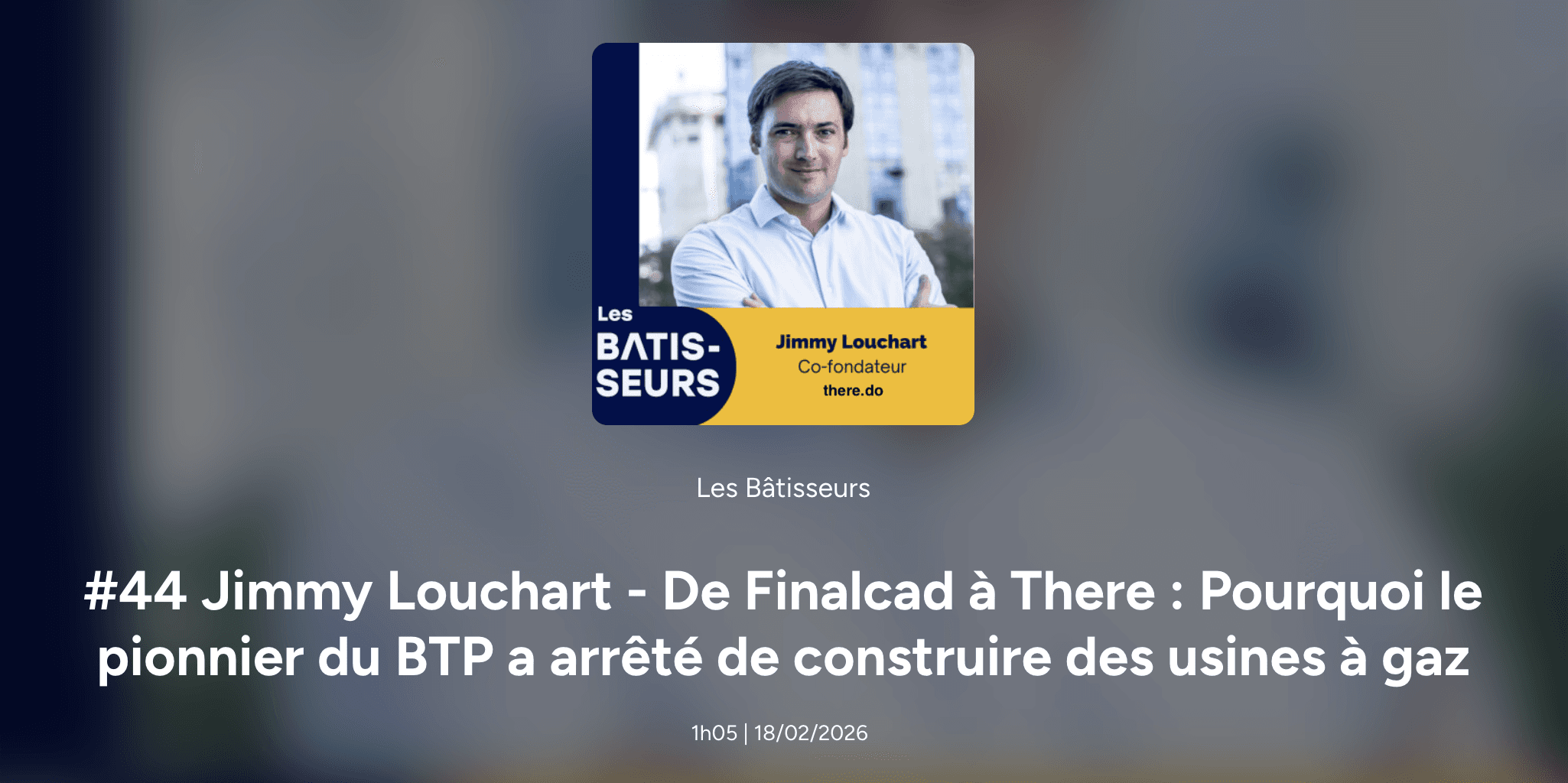
Based on my appearance on the Les Bâtisseurs podcast (#44), with Richad Mitha.
TL;DR
The fundamental mistake at Finalcad was believing that "going digital = killing paper."
A jobsite is not an assembly line: unique contract, unique location, unique teams → what people need is freedom.
The further you get from the field, the more you compensate with process — ending up with forms + PDF exports: fine for standardizing, but bloatware for a one-off project.
Tools that duplicate reality — execution BIM, digital twins — are outcomes, not prerequisites. They need to be built by doing.
there is testing the opposite approach: paper-first + invisible AI + document building blocks, to write fast… and actually get read.
It started there — in the field
Before Finalcad, there was a rite of passage: dust.
2007–2011: Knowledge Corp. We filmed construction crews, compared teams, broke down work methods. We worked with EDF, Bouygues Construction, Soletanche Freyssinet, Spie Batignolles — major French GCs. One example: we helped simplify Bouygues's B07 formwork system by filming three crews, strong ones and struggling ones. We identified more efficient moves, small tricks with dead-simple tools. Result: concrete changes Bouygues rolled out across every B07 unit.
What that period taught me is irreplaceable. We barely paid ourselves, but we understood jobsite common sense. That closeness to the crews, that feel for simplicity — it became the foundation of everything I built after. And it's what I almost lost sight of.
Then the spark: on a Spie Batignolles project, a superintendent is doing a punch list walkthrough — notebook under his arm, A0 drawings spread on the floor. The iPad had just launched. The idea was almost naive: put the plans on the iPad. That's how Finalcad started: "where is the problem" mattered more than "what is the problem." The pin on a drawing became the atomic unit.
Getting there too fast
Early on, we hacked the market with a price anyone could understand: $1 per square meter. You'd look at the jobsite sign and do your math on the spot.
The sales demo? We literally threw iPads on the ground. We'd found a rugged case, and we'd toss the tablet in front of superintendents to prove it wasn't a toy. Pierre Vauthrin, in Singapore, would walk up to a Japanese PM's desk, grab the paper ream, and throw it in the trash.
Then international took off: Series A to open Singapore, a challenge deal with Bouygues on the Sports Hub, and major accounts that accelerated the machine. Takenaka, Shimizu, Obayashi, and eventually a large contract with Fujita with guaranteed revenue over four years. We raised $18M, then $45M. We rebuilt the product from scratch with Metalab (the design firm behind Slack). Landed a $5.5M three-year deal with Eiffage. Hit $11M ARR. 300,000 users across six countries.
But.
We weren't there anymore
We kept selling business processes to general contractors — and we got stuck. Fifty-plus workflows. A "management dashboard" everyone asks for but nobody looks at. Features stacked on features like a patchwork quilt. It's the classic ConTech trap: you respond to client requests, you add, you complexify, and one day you look at your product and don't recognize it.
We lost touch with the jobsite. We were selling complex enterprise contracts, flying high. And that's when a simple law kicked in: the further you are from the jobsite, the more structure you add to reassure yourself. It's human. And it's dangerous.
The answer was there all along
The key line from the podcast isn't "AI" or "BIM."
It's this: every jobsite is a unique contract, unique location, unique moment, unique companies working together. So people need freedom, adaptability, flexibility.
Our mission should never have been to "digitize" paper. Paper is the center of everything. When you show up with a process-digitization mindset — structured forms, rigid workflows, PDF exports — you're going against that reality. You're forcing people who build prototypes to use tools designed for factories.
Joseph Lasserre, founder of Groupe Doumer — a guest on Matthieu Stefani's top French business podcast — lives this truth. He acquires small construction firms: roofing, plumbing, metalwork, tiling. And he sets one rule: companies of 20 to 40 people, capped at $5M in revenue. Not because he lacks ambition. Because he knows: at that size, every person matters, decisions happen close to the work, and quality stays manageable. Organizing a construction company isn't about org charts — it's about proximity.
Lasserre puts it differently: the pride of building comes when crews are set up to do great work. Technically interesting projects, leadership that helps people grow, tight operations. Not overhead that bogs down decisions that need to be made right there, on the jobsite.
Xavier Huillard, who led Vinci for 15 years, built the same conviction — at the scale of an $80B company. His line: Vinci isn't a whale, it's a school of fish. The group operates as a network of over 3,000 autonomous business units, with only 250 people at HQ. Every unit has a real operator running it. Huillard calls this the "inverted pyramid": empower field-level entities, keep central functions to the bare minimum. His conviction: decentralization is the only way to grow without getting fat. And the biggest risk in a crisis? Managerial regression — the temptation of the center to grab back control.
What does construction tell you, when you listen to its people? Always the same thing: value is created on the jobsite — not in the system that claims to organize it from an office.
ConTech keeps ending up there
The problem isn't digitization. The problem is HQ-driven digitization: designing for the jobsite from a desk.
The "customizable" form
The market is full of serious tools. The point isn't to dismiss them. The point is their common engine: forms, checklists, templates, workflows, exports to share.
Procore, Fieldwire, Dalux, Finalcad — they all require upfront template configuration to define each process through an admin layer. A form builder to create custom forms, then push them rigidly to field teams.
It works well when the world is stable and the process is highly standardized — punch lists, typically. The people who requested the form are happy because data entry feels faster. Early adopters go hard, and you often end up with more data than before — more issues logged than without the tool.
But on a "prototype" jobsite, the hidden cost isn't data entry: it's the frustration, project after project, of needing to tweak templates with no easy way to do it… and the fact that the final deliverable is usually a PDF auto-pushed to subs, clogging inboxes and going unread.
The digital twin
Execution BIM and the digital twin — Autodesk with Revit, Dassault Systèmes with 3DEXPERIENCE — push the same top-down logic to the extreme: heavy upfront parameterization before the project even breaks ground.
My point isn't "it's bad." My point is: it's an outcome, not a starting point. The digital twin is extraordinarily powerful in manufacturing, where you build in series. But in construction, every building is one of a kind. Over-investing in parameterization translates directly into lost productivity — and remains out of reach for a specialty contractor, or even an architect during CA.
The same blind spot
Forms and digital twins reproduce the same reflex: predicting reality from a desk. It's exactly what Huillard fights on the organizational side: the temptation of HQ to multiply processes, directives, and reporting to feel in control from a distance. Except on a jobsite, reality changes every day. Digitization, BIM, digital twins are goals that should be built by doing — not heavy prerequisites the field has to absorb.
So we started there: with a blank page
This is there's founding thesis: don't start from the process. Start from the blank page.
Give people the same freedom as Word — because Word is everywhere, it works in every situation, it's unstructured. And let intelligence emerge over time: AI structures what humans captured freely, the document becomes readable, the jobsite gets back in flow.
In practice:
Capture fast. The architect starts a voice recording during a site visit. Takes photos. AI generates a detailed summary. No more staring down at your phone — you can actually look at the jobsite.
Stay in the document. Back at the office, notes appear in a web document. An AI agent proposes dispatching them into the field report. The human reviews, adjusts, approves. AI isn't on the side — it edits inside the document. No copy-paste breaking your formatting.
Share smart. You don't share a PDF: you share a link to a page — mobile-friendly, responsive, adapted to the reader. The architect knows who read it, who didn't, and can follow up in one click.
Where form-based technology demands structure, paper invites freedom. there tries to be both: the freedom of paper, with the intelligence of technology underneath.
Notion gets you there — almost
On the podcast, I mentioned Notion as a reference. Ivan Zhao's vision illuminates what we're building — and its limits illuminate what's left to invent.
Zhao has a line that says it all: the original promise of computing was a new kind of clay — a material you shape to your needs. Instead, we got appliances: built somewhere else, sealed shut, unchangeable. When you have 20 rigid solutions stacked on your desk, they don't fit together. You can't tinker with them. Zhao wants the opposite: LEGO bricks everyone assembles their own way. Imagine your apartment was laid out by someone else, from a remote office. You'd want to move the furniture, customize the storage to fit the way you actually live. Software should work the same way.
That's exactly what architects experience with current ConTech tools: floor plans imposed from above that you can't rearrange. there wants to be the opposite: a space you live in and reshape — not a furnished rental bolted to the floor.
But Notion stops at the company door. And construction is the exact opposite of a single company: it's a temporary collective of dozens of independent firms that have to work together on a unique site, for a limited time, then split up and start over somewhere else with different partners.
That's why no classic per-seat SaaS has ever penetrated construction deeply. A specialty contractor works on ten projects a year with ten different setups. If they had to pay a subscription for every tool required by every architect or GC, they'd go broke. So they ask for a PDF. And the PDF becomes the lowest common denominator — not because it's good, but because it's free and universal. ConTech vendors all end up producing PDF exports nobody reads. The snake eats its own tail.
there is architected for this multi-company reality. The business model is per document — not per user, not per project. Notes are free forever, with AI that pairs voice memos and photos: no more notepad on one side and phone camera on the other, painful to import into Word. And most importantly: documents are readable without an account, without a login, fully responsive, with AI accessible to every reader. Field reports carry legal weight, punch lists create liability, daily logs become evidence — all of it needs to flow freely between companies that don't share the same software, the same budget, or the same digital maturity.
The right construction software isn't the one a company buys — it's the one an entire jobsite uses.
What we're building from there
The goal isn't to add another layer.
It's to stop building systems that force teams to work until 10 PM filling out forms, then send a PDF nobody reads.
Joseph Lasserre talks about the pride of building. Xavier Huillard talks about local entrepreneurial energy. They're using the same words for the same reality: in construction, value is created in the field, by autonomous, accountable people who make decisions fast and well.
Construction software should amplify that energy — not suffocate it. It should make people proud of their documentation, not burden them with one more form. It should flow naturally through the jobsite, like a note you hand to a colleague — not an ERP you feed reluctantly.
Finalcad taught us how to build. there is teaching us how to unlearn.
Construction is a world of prototypes and temporary collectives. So digitization should be an outcome that emerges, not a prerequisite that constrains. And software should be as decentralized as the jobsite itself: accessible to everyone, paid for by the one who produces, read by the one who receives.
The decision has to stay where the work happens.
Listen to the full episode: #44 — Jimmy Louchart, from Finalcad to There: why the ConTech pioneer stopped building bloatware — Les Bâtisseurs, by Richad Mitha (in French).
Also listen: #525 — Joseph Lasserre, Groupe Doumer — Génération Do It Yourself, by Matthieu Stefani (in French).
Read: Growing Without Getting Fat: Vinci's Management Model — Xavier Huillard, L'École de Paris du management.
Jimmy Louchart
Cofounder