CHABANNE
Architect

Report No. 75
On Tuesday morning, Rémi Relave enters the site meeting. As the person in charge of the Works Management and Execution mission on the Enedis Eco-campus in Saint-Pierre-la-Palud, he coordinates between thirty to forty participants, trade contractors, the technical controller, and the client. At the end of each session, everyone expects a precise report, sent quickly and indisputable.
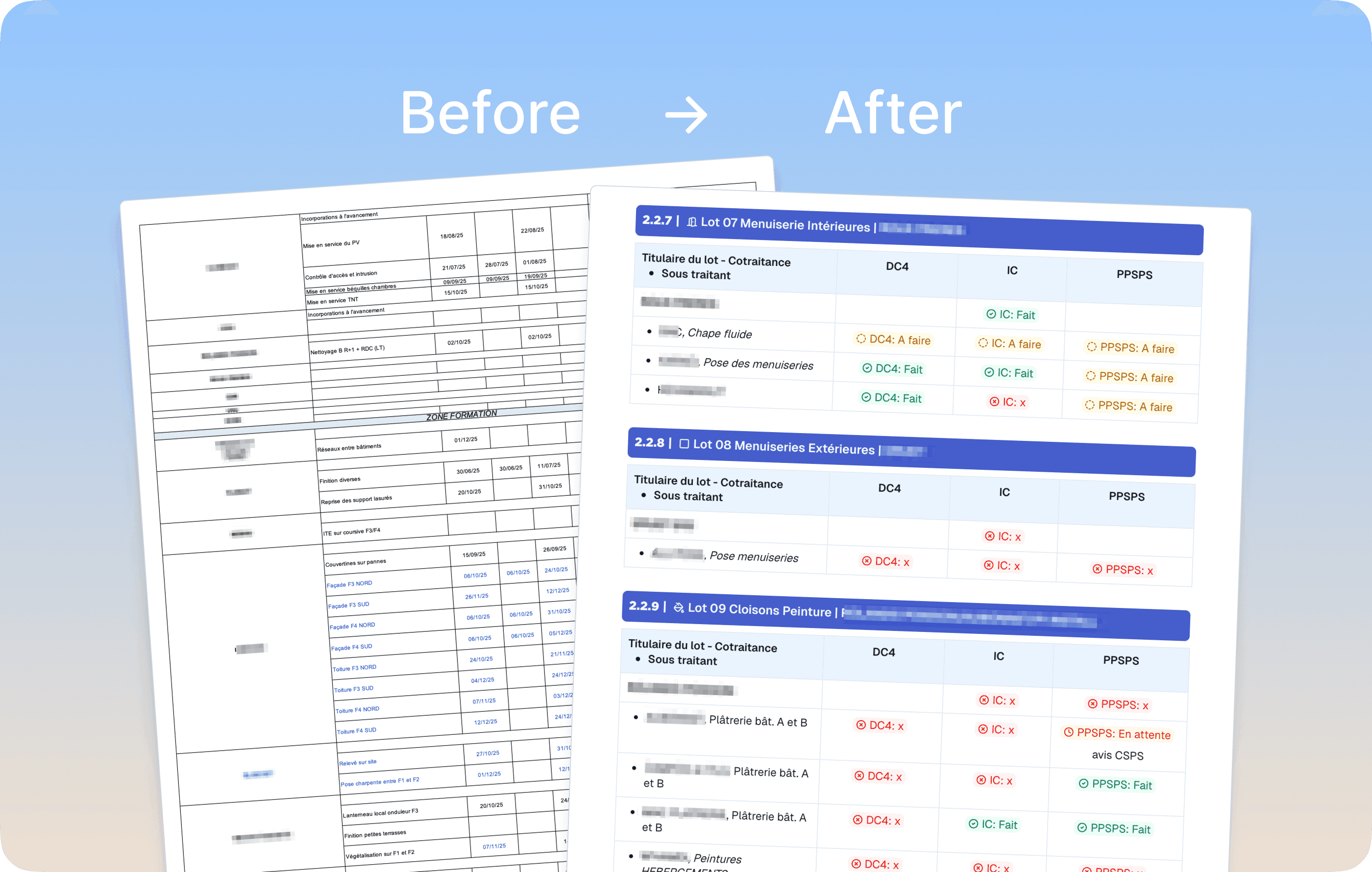
Before, that Tuesday triggered a tunnel. iPad notes, iPhone photos, Plaud recording: three streams to consolidate in Excel. Two hours of post-meeting cleanup, sometimes more. Distribution often on Thursday. Rémi has a word for it: laborious.
“The person I was replacing on this site used to spend more than half a day on their report. For over four hours, you do nothing else.”
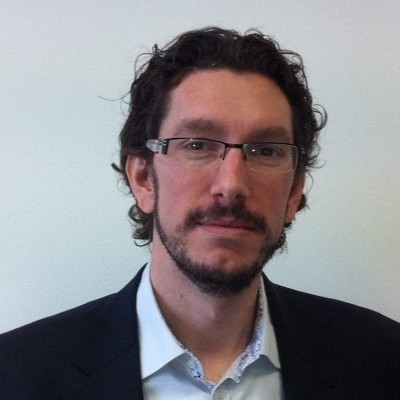
Rémi Relave, Chabanne
It wasn’t a question of method. It was the very structure of the problem. “The intelligence comes entirely from the user.” Every report started from scratch with him. Consistency from one report to the next, photo management, task tracking—everything rested solely on his rigor. On a site with penalties to document, personnel to check, dozens of active tasks: it eventually weighs heavily.
Report No. 75
In November 2025, Matthias Greuet at Chabanne discovers there and suggests Rémi try it. The decision is clear: the Enedis site’s report No. 75 will not be done in Excel.
One single report is enough for him. “After just one report, I was convinced.”
“After just one report, I was convinced.”
What convinces him isn’t a product demo. It’s during the meeting itself. He projects the document being drafted live. He clicks on a photo taken that morning, “the poorly executed reservation at R+1,” “the defective finish.” The image appears full-screen, in front of everyone.
“The photo is there. And there, there’s no more debate.”
In construction, site meetings often rely on diverging memories—each person saw something, remembered something. The timestamped photo, projected next to the report in front of all participants, doesn’t need to arbitrate. It aligns. Not because the tool is sophisticated. Because reality is there, in the room, shared.
A meeting that writes its own report
The there mobile app is used in two distinct contexts, and their combination changes everything.
During site visits, before or after the meeting, Rémi starts a voice recording and takes his photos. The AI transcribes, summarizes, and links the notes to the images. Back at the office, everything is ready: a structured visit report, with photos captioned directly. No more notebook, no more imports, no more synchronization between three tools. “It’s an incredible memory aid.”
During the Tuesday site meeting, he opens the previous report, projects it on the meeting room screen, and completes it live. The visit notes and photos are right there, next to the document, in split-screen mode. When a dispute arises, he clicks on the photo. It displays full-screen in front of all participants.
“The fact of doing my site visit by taking photos, recording what I say to myself, and then coming back to the meeting and seeing it all in split-screen with the report—it’s extraordinary. I’d never seen that before.”
At the end of the meeting, 80% of the report is written. The remaining 20% is handled right away. “It’s not even half a day.”
Distribution now happens systematically within twenty-four hours. That timeframe changes more than it seems: it enables a cycle that the previous 72 hours made impossible. Report on Tuesday, requests for feedback to contractors by Friday, preparation on Monday, meeting on Tuesday. The contractors stick to it, 20% comment directly in the document, some the same day.
Changing the paradigm
Rémi has a formula to describe what there changes in the way of working: “It’s the difference between Netflix and the cinema.”
It’s not a question of speed. It’s a different relationship to the tool. Excel imposed a service relationship: you served the document to produce the report. With there, there are automations from one report to the next, effortless continuity, a template that stabilizes on its own. Part of the load is carried by the tool—not the intelligence of the content, which remains his, but the consistency of the form, week after week.
This shift frees up attention. By reviewing his photos and the summary after the meeting, Rémi recovers elements perceived on site but not memorized. He stopped taking handwritten notes. He looks at the site. The tool captures, structures, restitutes. He decides.
“If tomorrow I had to go back to Word or Excel, I’d be miserable.”
A new era of efficiency
There’s a context Rémi names directly. “I’m not sure that if you had launched there in 2018, it would have worked as well as today.”
Covid created a gap. Not just technological, but behavioral. Teams tasted a different balance. No more staying in the site office until 9 p.m. Efficiency on site became a condition for being more present elsewhere. “We need to be more efficient on site to be a bit more at home.”
This shift didn’t reverse with the return to the office. It became anchored. And since then, generative AI has accelerated what Covid started: the conviction that time spent producing documentation must be reduced to the strict minimum—not out of laziness, but out of clarity.
there fits into this shift. Not as one more tool, but as a response to a profession that has changed its own demands.
What we build together
Rémi is not a passive user of a product roadmap. He’s in the loop.
He spontaneously cites the reactivity of the there team as an argument for recommending the product to a colleague: “People capable of responding in less than 12 hours and implementing a solution in less than 48 hours—I’ve never seen that.” It’s not customer service. It’s co-construction.
And like any honest co-construction, it includes what remains to be done. Rémi has two open topics.
The exhaustiveness of the AI summary on long recordings. For two-hour meetings, the current summary is too condensed; some topics are skipped. He compares it to Plaud, which is more exhaustive on this point. The direction is clear: an AI that restitutes more, not less.
Email from the photo. After each visit, Rémi downloads his photos, identifies recipients, drafts reminders manually. He sees exactly what would be needed: from a photo, there suggests the recipient and proposes a first draft. “Attention, this element has not been removed even though we said to remove it.” It’s not an abstract idea; it’s his daily workflow, described precisely, awaiting a response.
What Rémi would not want to lose if there disappeared tomorrow, in his words:
The connection between mobile and web
Having automation from one report to the next
Having something that is traceable.
Three answers. None about an isolated feature. All about continuity—between the field and the document, between one week and the next, between what was said and what can be proven.
About Chabanne
Chabanne is an architecture and engineering agency specializing in complex structures and projects. The agency’s added value lies in the close integration of its skills and expertise. The cross-disciplinary blend of its architecture and engineering professions enables it to approach projects with a comprehensive (eco)responsible vision: from design through to construction and operation. More than 10 different professions work hand in hand on every project, across its 4 offices in France (Lyon, Paris, Marseille and Saint-Étienne).

