UNANIME ARCHITECTS
Architect

1 report
To make the switch
72 weeks
Of history migrated
2 types
Of documents
Switch
Spring 2025
Previous tools
Excel
Outcomes
Show it, don't just describe it
From the field to the document in one move
Meeting reports and submittal reviews in the same tool
“The meeting report is the contractors' to-do list.”

Yacine Benameur, Engineer
Construction Administration and Project Scheduling, Unanime Architects Alpes
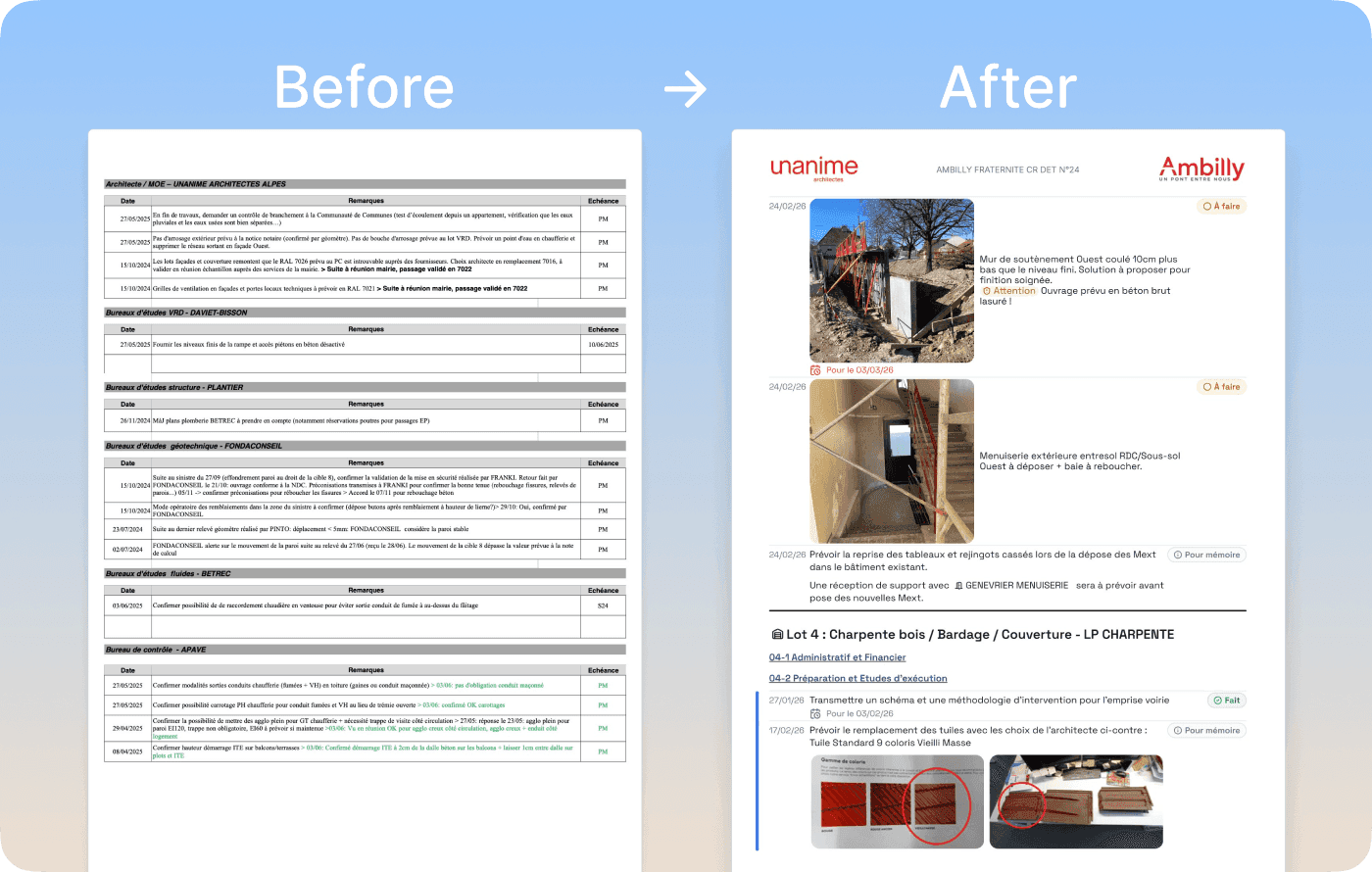
Sixteen pages. Zero photos.
That's the meeting report Yacine Benameur is still sending in spring 2025, right before making the switch. Sixteen pages of tables, columns of dates and deadlines, observations in plain text. A 71-unit housing project, twenty-five trade packages. Everything is there: attendance, weather delays, approvals, crew counts, finish selections, open items. Everything exists. Nothing stands out.
"And I'm someone who's a little obsessive about these things. It just wasn't working."
there, the work changes
Before Unanime, there was Vinci Construction.
As a full-time site superintendent on a single project: a fixed address, subcontractors cycling through the office, a meeting report typed live in Word. Tedious in form, functional in substance. When you're on site every day, context fills in the gaps.
In 2023, Yacine joins Unanime Architectes Alpes. The pace changes entirely. Not one project — three. Not on site full-time — constantly moving. Before each meeting, he has to reorient himself, pick up the thread, check what's moved forward and what hasn't.
His workaround, for a while, is simple: print the previous report, annotate it on site, then retype everything back at the office in the evening. When it rains, he writes anyway. The ink sometimes runs.
After a year of this, something becomes clear: the document records. It doesn't communicate.
there, he holds his ground
Yacine has a clear line on his role, shaped by years on the contractor side before moving into construction administration.
“My value-add is anticipating issues, planning, verifying. It's not holding the painter's hand and walking him through touch-ups unit by unit.”
A good meeting report protects that boundary. Transmit the information with enough precision, then hand responsibility back. "The meeting report is the contractors' to-do list." But a text-only to-do list has limits. Some things can't be described. They have to be shown.
there, four plan extracts are enough
On October 2, 2025, Yacine flags an issue: in the basement, certain sleeves and utility connections to the site infrastructure are missing. To be resolved before the utility crew's intervention in week 43. Below that line: four annotated plan extracts. Four red circles. Four precise locations. One deadline.
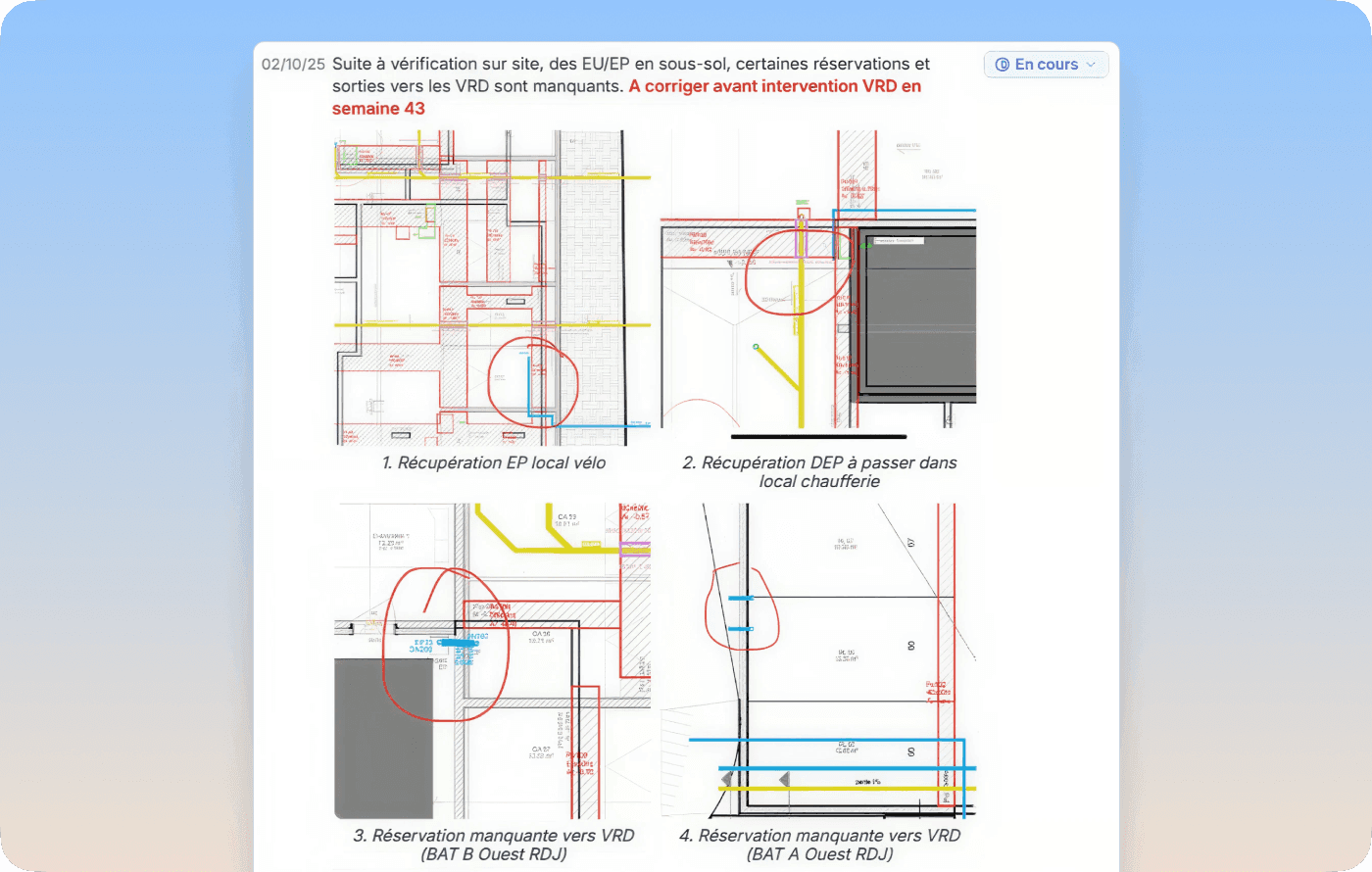
In his old report, that same information would have existed mainly as text. The superintendent would have had to call, or wait for the next meeting. Here, he has everything. Yacine doesn't need to follow up in person.
“Not doing the superintendent's job for them — that's a principle. What helps is being able to illustrate certain requests.”
This shift wasn't a conscious decision. In Excel, capturing a photo on site, exporting it, importing it into the spreadsheet — enough friction to never actually do it. With there, photos are right there alongside the document, in the same window. He drags, positions, captions. The document changes character without Yacine having decided to change his method.
there, the field enters the document
The transition doesn't go through a pilot.
The Rumilly project, its 72 weeks of history, its tabs, its layers of heterogeneous data — all of it moves into there on the very first report.
“The output was clean. And when I spotted something off and gave feedback, it was fixed within 24 hours. That's gold. It makes you want to keep using it.”
What follows is a different reading standard. The next meeting date is visible the moment you open the report. Items are organized by context. Statuses — For the record, Pending, In progress, Done — read at a glance. Photos live directly alongside the item they belong to. The contractual sections — payment applications, weather delays, safety coordination, crew counts — stay rigorous while becoming readable.
The document no longer just accumulates. It guides.
there, the same standard extends to submittal reviews
Yacine's story doesn't stop at the meeting report.
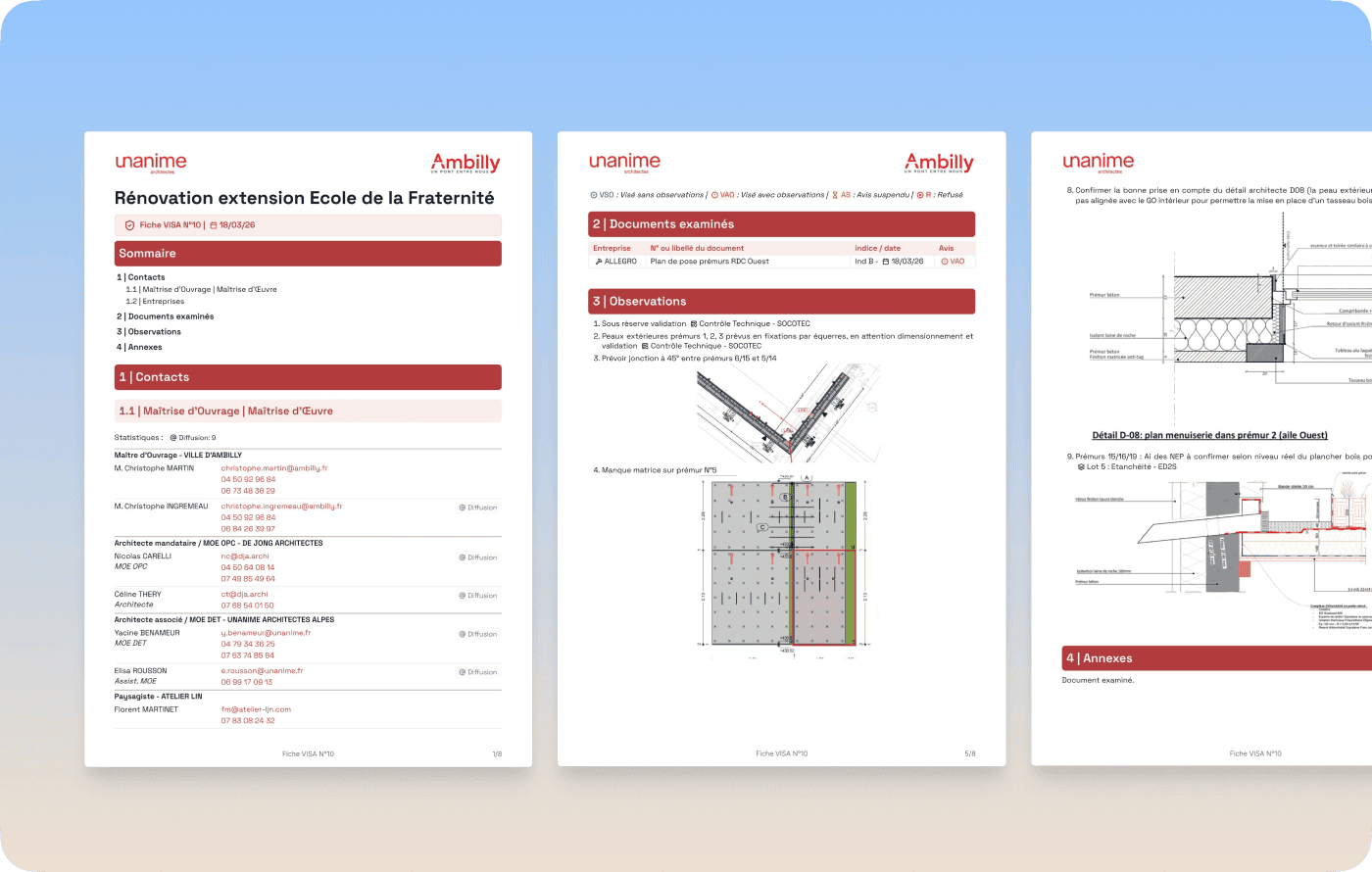
Submittal reviews formalize the design team's comments on contractor-submitted execution documents. In there, Yacine applies the same logic: don't just write the observation — make it visible.
On Submittal Review No. 10, comments are numbered and directly supported by plan extracts embedded in the body of the document: missing bearing plate on precast wall No. 5, missing MEP sleeves, elevation to be revised, architectural detail to confirm. The issue and its visual evidence live together.
“Annotations directly in the document, approval status labels, attached files — visually it works well. It lends itself to this pretty naturally.”
This isn't a use case that was planned. It's one he mapped over himself.
there, the product lives in the details
Yacine has a precise list of changes he requested and saw shipped: the "For the record" status, the ability to check off participants in the distribution list to automatically add them to the share, improved table formatting, adding "Due" in front of deadline dates, a task creation date that no longer resets to the following day when the report is written after the meeting.
"Tons of them" — that's his answer when asked for examples.
And like any honest co-building relationship, it includes what's still on the list: offline access to the previous report during site visits.
What Yacine wouldn't want to lose if there disappeared tomorrow, in his own words:
The mobile / web pairing
Having field notes directly alongside the document
A document that makes people actually want to read it
In the end, that might be where a tool earns its place. Not when it replaces the work. When it finally lets you do it right.
About Unanime
Unanime Architectes is a multidisciplinary architecture group with four subsidiaries dedicated to architecture, interior design, healthcare, and construction. Built around shared resources across practices, the group operates from offices in Lyon, Paris, the French Alps, and Bahrain, delivering complex programs — public facilities, renovations, commercial, and residential — from design through project closeout.

