VIBATI
Works Supervision Consultant

2 reports
To make the switch
4 reports
Per week
13
Product updates
Switch
Report #43, July 2025
Previous tools
Word
Outcomes
Spend less time on formatting
Defend every decision in a dispute
Give owners an instant read
Thomas Vittoz is looking for the date he requested a quality control checklist.
Before, he opened his PDFs one by one.
The project moved on. The issue came back. A trade contractor disputes it. A follow-up is missing. A question of liability is on the table.
This time, remembering isn't enough.
He needs to prove it.
There, Word was never the real problem
Thomas Vittoz started at Bouygues Bâtiment Grand Ouest after engineering school. General contractor, excellent training ground. First project, a hospital — up to twenty superintendents, each tracking their own trade package in a shared Excel. You learned the work by osmosis, on site. On his next project, a residential development, Thomas was on his own. He developed two types of meeting reports there: one for the trade contractors, a lighter one for the owner.
But the commutes kept stacking up. When the founder of T2T Bat offered him a move to construction administration in 2020 — "you'll be home every night" — he followed.
The role shifted: less direct supervision, more oversight. With a colleague, Thomas built out the method. A shared server, folder structure, Word template, internal conventions. "We started from a blank page."
In October 2024, he founded Vibati in Nantes. Alone.
He kept the Word template he knew. It wasn't bad.
On Dolce Vita — a Bouygues Immobilier development of 71 units — his meeting report covered 25 trade packages across 37 pages.
Color-coding maintained by hand. Numbered follow-ups. "FOLLOW-UP #2." "FOLLOW-UP #8." Sometimes "FOLLOW-UP #18."
The template held.
But it held because Thomas held it.
The problem wasn't the template. Thomas knew what he was doing.
The problem was what the report had to carry.
“The job site meeting report has contractual value — but it's also my running thread for the whole project. I empty my head into it.”
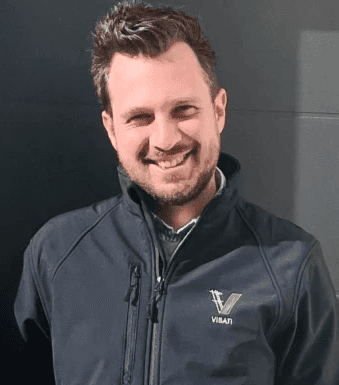
Thomas Vittoz
Vibati
In any given week, Thomas is tracking five projects at once. He prints the previous report, annotates it during the meeting, pulls photos from Fieldwire, sweeps through the week's emails in Outlook. He picks up open requests, consolidates what needs to go to the trade contractors, the owner, the engineering consultants.
The document isn't a summary. It's his active memory.
And when that memory lives in separate PDFs, it starts to cost you.
"In Word, I had no date. When I was trying to find something — like, I already told them this three months ago — I'd end up reopening all my PDFs."
There, the dispute always asks for the same thing
Thomas talks about construction disputes without drama. He's seen them in earlier roles.
A water infiltration. Basement flooding. A waterproofing failure. A balcony. A quality control checklist that was never transmitted. When a claim surfaces, the first move never changes: the expert asks for the meeting reports.
The expert isn't looking for intent. They're looking for a record.
The question becomes: what was requested? On what date? To which trade contractor? With what follow-up? What response? What owner refusal? What non-reply?
They're trying to establish whether the construction administrator bears any responsibility. Even when the work was done carefully, a residual share can land on you. On major issues, everyone defends their own perimeter.
"It's not a fun moment."
You pull the evidence. The emails. The photos. The meeting reports. Everything that shows the alert was raised, the request was written, the contractor didn't follow through, or the client failed to make a call.
Thomas says it the way a site person talks, not a lawyer: "Unfortunately, we told them — and we can't do it for them."
That's what the report is for too. To hold that line.
There, staying solo becomes a deliberate call
Thomas is at a threshold.
Almost too many projects to manage alone. Not quite enough to justify a hire. One project starting up, three heading toward closeout before July, one large residential development of 150 units still running. Business development could bring in more work. But that means hiring — or saying no.
"I'm right at the edge of taking the step. I just need to be ready for it mentally."
In the meantime, he holds. Days that spill into evenings. "Right now I'm working quite a bit at night." Meeting reports get done after dinner, between deliveries.
In that zone, every friction weighs more. A sole practitioner doesn't have an assistant to clean up his notes. No support staff to maintain a template. No team to dig through the archive when an expert calls. He has to produce, distribute, retrieve, and defend — all of it.
The meeting report isn't one administrative task among many. It's the minimum infrastructure for a solo CA.
And in a dispute, it's the only one he'll have.
There, the switch didn't change the work
Thomas had been looking for months. He tested several options. Every time, the same worry came back: losing the freedom of Word. A locked export. A template making decisions for him. A report that always comes out looking the same.
Word takes time. But Word lets you work.
Thomas wanted to keep that freedom — without keeping the mechanics that came with it.
In July 2025, an outreach came in over LinkedIn. A simple offer: take one of his existing reports and format it. Thomas chose report #43 from the Dolce Vita project, Thursday, July 3, 2025. He gave himself two months.
Within one month, he had already moved his second and third projects over.
"I think after about a month, I was already running the second and third projects through there — telling myself, okay, the trial worked, this settles it."
What lifted his hesitation wasn't the AI. At first, the AI even worried him a little — he didn't want it taking over how he organized his report. He ended up using it in small doses: rewording a note, drafting an email listing the trade contractors called to a meeting.
The center stayed the same: his judgment, his structure, his project.
The difference was in the gestures he no longer had to repeat.
There, the record becomes searchable
Thomas still works like a CA. He prepares, prints, annotates, re-reads his emails, checks his photos, consolidates. But action items are no longer just lines in a document.
A request carries its creation date. A deadline turns red. A status changes without breaking the layout. A closed item archives without disappearing. A new point shows up with a blue stripe — the habit of bolding things by hand is gone.
Then came @reminder. Thomas surfaced the need. The logic followed in his reports: first reminder, second reminder, then the counter stops when the item is closed.
A follow-up isn't just a repetition. It's an escalation of accountability.
Other adjustments follow the same logic: archive without losing, create a note from a forwarded email, keep crew counts in a usable block. Not to add features. To keep the record from scattering.
The gain looks small. That's the trap. Updating a date, numbering a report, archiving a closed item, finding an old topic, cropping a photo, verifying what was requested — each gesture takes a moment on its own. Repeated across four or five reports a week, it adds up to a real part of the job.
Thomas puts the gain at fifteen to twenty minutes per report. He doesn't pitch it as a transformation. And those minutes don't go toward comfort — Thomas still works nights. They go back into the technical work.
He looks more carefully at certain shop drawings. He checks the details that can become claims — water management, downspouts, waterproofing, balconies, the things you sometimes let slide because you trust the contractor, while keeping a doubt in the back of your mind.
His most important line isn't about a tool.
“My value isn't the job site meeting report. It's the technical knowledge — the ability to anticipate issues before they surface.”
Thomas Vittoz
Vibati
There, the document has to earn its readers
Thomas doesn't tell himself that every trade contractor reads meeting reports carefully. Some show up with the page that covers their package printed out. Others skim. Some barely open it. "Some superintendents are so underwater — running 20 projects — that they read super fast, or don't open it at all."
Readability isn't a presentation issue. It's a condition of proof. A request a contractor doesn't read will have to be repeated. Then repeated again.
"It's almost a sales job — convincing the firms to come read what you wrote about their package."
The word is right. Not to look good. To get the action.
And when a contractor disputes something on site that they hadn't looked at in three weeks, Thomas can see it in the read tracking. "You can tell them: read it first, then come talk to me." Readability draws them in. Read tracking settles the argument.
A superintendent from SMAC wrote to him one day: "You're the one who does the report with the link — really well done." Thomas took two things from that. He read it. And he understood it.
On the owner's side, progress percentages and crew counts make the project legible without a weekly site visit. One client told him that in a few seconds, he could see exactly where the project stood.
What's still missing
Thomas already sees the gaps. Updating a task status from his phone in the middle of a site visit. Pulling photos from Fieldwire more directly. Exporting all the PDFs from a project in one shot if an expert requests them. Maybe someday linking a video when a water leak is easier to understand in motion than in a still frame.
These aren't abstract ideas. They're situations where the record needs to follow the field.
Thomas isn't looking for a more modern report. He's looking for a record that holds when the project is gone.
The job moves on.
The report stays.
About Vibati
A construction administration firm founded by Thomas Vittoz in October 2024, based in Nantes. Following roles at Bouygues Bâtiment Grand Ouest and T2T Bat, Thomas provides CA, scheduling and coordination, technical oversight, submittal review, project closeout, and construction management services — primarily on residential developments in the Pays de la Loire region.